The 1981 Warren Beatty film Reds is monumental. Over the course of three hours and fifteen minutes (with an intermission), it tells the story of John Reed and Louise Bryant, two American journalists who most famously witnessed the Bolsheviks take power in Russia in 1917. This story shows the contradictions within love, within revolutionary politics, and between the two. The protagonists struggle to reconcile their personal ambitions and desire for freedom with the polyamor-ish love that ties them together (John definitely did not read The Ethical Slut). This trajectory is illustrated when, each time that John asks her to come with him (to New York, to France, or to Russia), Louise demands to know “what as?” After failing to respond to this question throughout the movie, they ask each other one more time in the last scene. Finally, they venture an answer: “Comrades?”
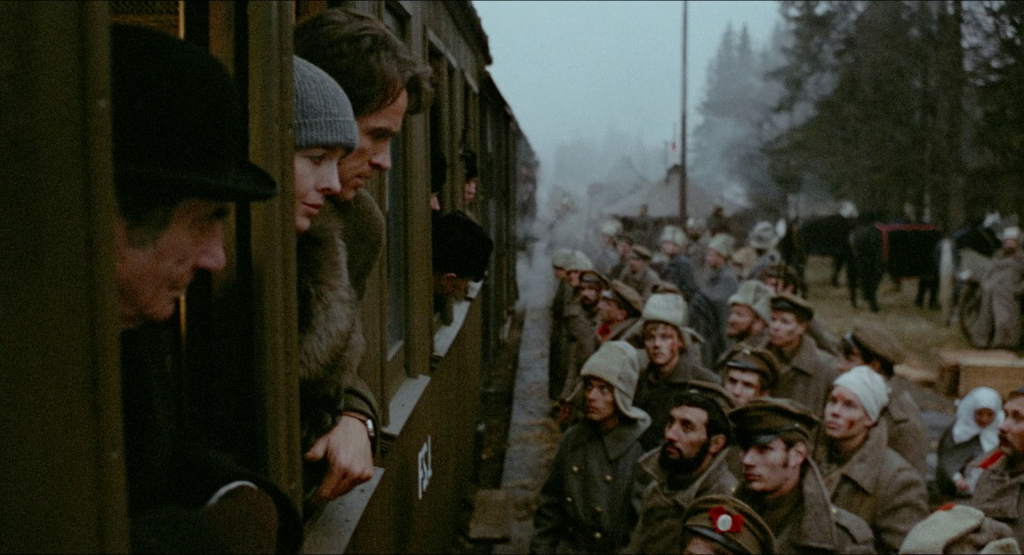
You may get more out of this movie if socialism (or trying to change the world through some other framework) is an important part of your life. For me, though, there was so much more to connect with. As a writer and political blabbermouth, the contradictions illustrated between truth and political agitation were insightful. As a trans woman, I related to Louise. In our own ways, we both found joy as women only later in life — and when you get a second life, living feels urgent. Like her, I feel like I have to love freely and a lot, while also fighting for a world worth living in. Unlike in her time, I don’t see any revolutions in the immediate future, but all that means is more time to organize and to fall in love.
On another level, Reds is about remembering. Interspersed throughout the story are recollections from real people, alive at the time of the movie’s production, who knew John and Louise. Some remember them well while others don’t. Even as a socialist and a fan of history, I had never heard of either of them more than perhaps passingly. This is especially egregious because, as we learn in Reds, John Reed was born and raised here, in Portland. And as far as I can tell, the only memorial to him outside of his grave in the Kremlin Wall in Moscow (where he is one of just three Americans1) is a bench in Washington Park. So I went on a field trip.
On Tuesday evening it had been raining all day and the trees were battered from violent winds. As I drove up along the edge of the park, I turned off my music2 to absorb the atmosphere. I parked at the Rose Garden at 8:01 p.m. (I remember because parking is free after 8) and began making my way down through the park. The rows of roses and rustic lamps evoked the time period of John’s youth in Portland. However, as I began to reflect, this was entirely the wrong place to commemorate him. The bench is located near the place where his childhood home in Goose Hollow stood, and even today, the neighborhood just outside of the park is extremely affluent. However, John left Portland quickly, complaining that it was boring and deeply conservative, and spent most of his adulthood reporting on strikes, wars, and revolutions. He was drawn to dirt and discontent, not the mansions and manicured gardens of his upbringing.
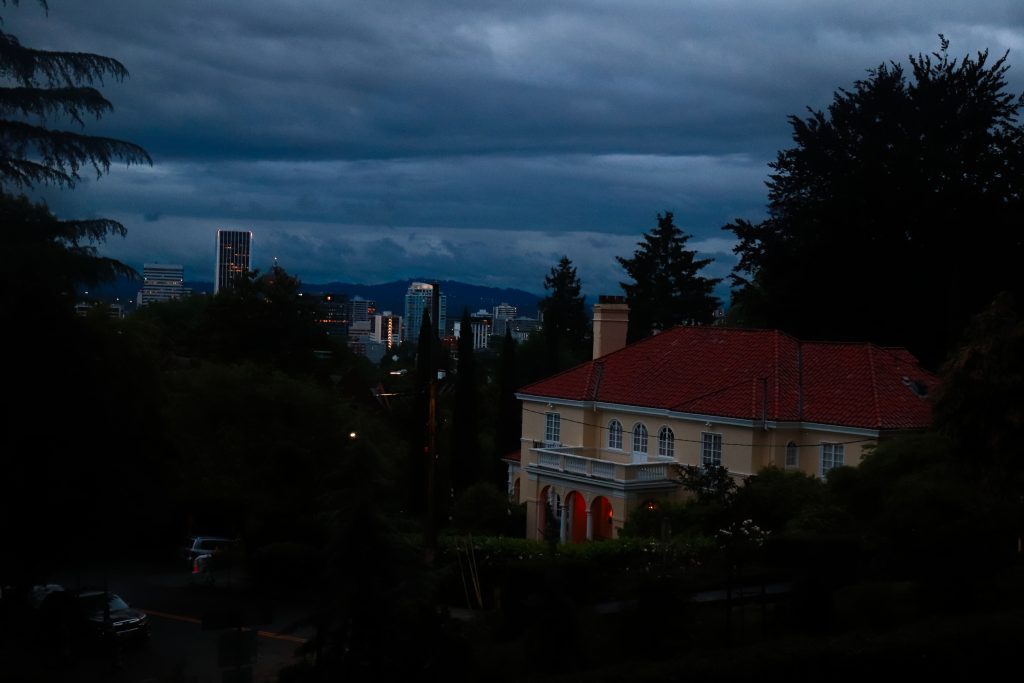
The irony of commemorating John Reed in Washington Park doesn’t end there. The bench, which was built in 2001, is dwarfed by the nearby Lewis and Clark Column. A communist agitator would not have appreciated having such famous colonizers as neighbors. As I walked down the paths, covered with needles, branches, and pine cones thrown from the trees, the location of this memorial felt more and more like a cruel joke. I couldn’t see any place in this beautiful, rustic park in a bourgeois neighborhood for a sworn enemy of the capitalist class. Then the wind picked up, making the evergreens roar, and I saw the grey clouds moving at a sprint. I caught glimpses of the blue sky and gleaming white clouds behind them. If I had to guess, I would say John’s place was in the violent wind pushing the clouds and the glimpses of better weather that it revealed.

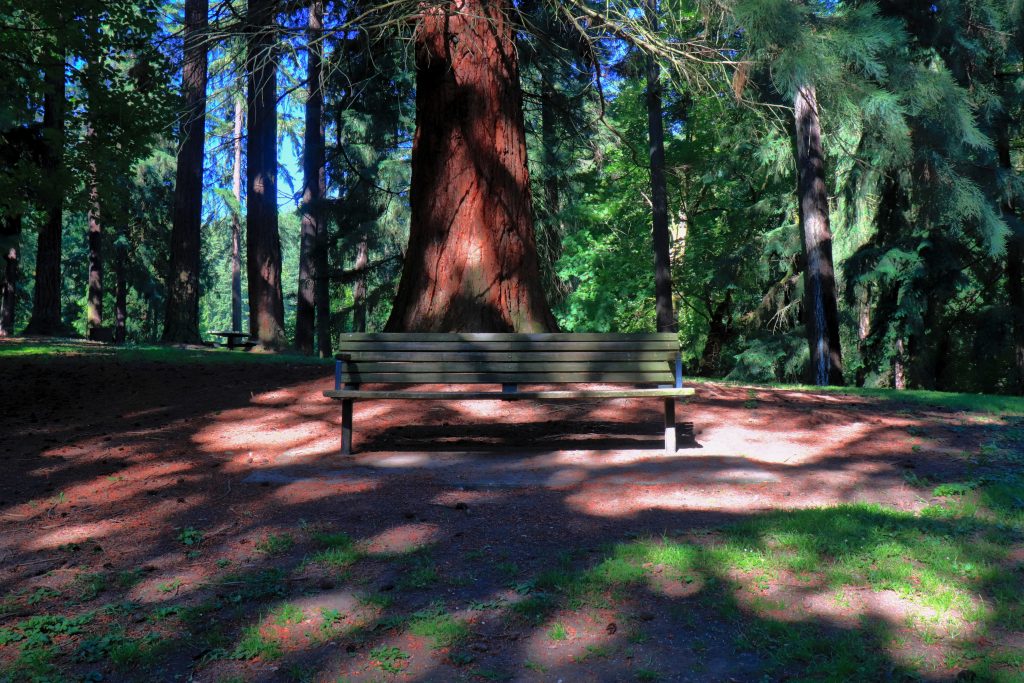
After getting lost, I backtracked and eventually found the bench. It was getting dark and my camera was low on battery, but there wasn’t much to capture. The bench was soaked black with rain, hidden in the shadow of an enormous pine tree. I got a good picture of the plaque, which I’d read about online. To add insult to injury, it doesn’t mention what John believed in and fought for at all. It mentions his book, Ten Days that Shook the World, but pointedly omits its subject (the October Revolution). It’s hard to find a Reed quote that isn’t radical, but they manage: something about how Portlanders uniquely understand the beauty of the Pacific Northwest3.

So in 2001, in a city considered one of the most progressive in the nation, a Portlander who fought for working-class revolution could receive only a hidden bench in the corner of a huge park with a plaque which erases his legacy. And it’s not much better elsewhere. When I mentioned Ten Days that Shook the World to my mom, she recalled reading a translation from her parents’ bookshelf as a child in Eastern-Bloc Poland. She was surprised by the author’s enthusiasm for a cause which by then seemed morally bankrupt. Even during his life, after the book was written, John became disillusioned with the Bolsheviks (though the degree of this is hotly debated), and the later use of his name and image4 in the Soviet Union reeks of cooptation. Now that the Soviet Union is gone, there’s not much attention paid to him in Russia. Just as, around the end of his life, principled communists like John were persecuted in both the US and the USSR, so today they have been forgotten in both.
Although it might sound like it, I don’t idolize John Reed. If Reds is accurate, he was ineffective, insensitive, and reckless on many occasions. However, he fought in earnest for a good cause, and that’s worthy of praise and imitation. So, for what it’s worth, I plan to visit the John Reed Bench5 occasionally, and to keep fighting for a city worthy of commemorating him. Together, we can keep the wind blowing, and maybe eventually the sun will come out. ◧
- In some places, the figure cited is five. The others that are listed alongside Reed are Big Bill Haywood, the founder of the Industrial Workers of the World, and C. E. Ruthenberg, the founder of the Communist Party USA. ↩︎
- Young Miko’s latest album, Do Not Disturb: Late Checkout ↩︎
- In full, the plaque reads as follows:
John Reed
October 22, 1887 – October 17, 1920
John Silas Reed, world-renowned journalist and author of Ten Days that Shook the World, was born at the family home very near this spot.
Oregon Cultural Heritage Commission
2001
Portlanders understand and appreciate how differently beautiful is this part of the world—the white city against the deep evergreen of the hills, the snow mountains to the east, the ever-changing river and its boat life, the dusty oriental brilliancy of Chinatown—and the grays, blues, and greens, the smoke-dimmed sunsets and pearly hazes of August, so characteristic of the Pacific Northwest. You don’t have to point out those things to our people.
– John Reed, Oregon Sunday Journal, August 1914 ↩︎ - For example, Reed was the face of a Soviet postage stamp commemorating his 100th birthday. ↩︎
- As it is named on Google Maps, where you can also find the location. ↩︎

